
This should be a review of what students already know: past tense verbs. You might be thinking, “Teacher, we already learned this in kindergarten! We even did this in class!!”
The fact is, students speak and write everyday without using the past tense correctly. ESPECIALLY the irregular ones. Yes, even you!!!
You can still get your idea across, even if you do it wrong, but it’s the same thing as saying something like this in Korean:
“어제 학교 가요.”
That doesn’t make sense, right? It’s the same for Past Tense Verbs in English.
First, make sure you know what a VERB is.
A verb is an action, or any word that you can stand up and do.

What is this verb?
Of course, it’s dance! Easy.
Sometimes verbs can be more complicated, like state of being verbs, but we aren’t thinking about those right now.
Next, what is the past tense?
The past tense means something is finished. You did it before, but now you are not doing it.
“Today is Thursday. I went to the store on Monday.”
Does this mean you are still at the store? Of course not, it means you went home already. Unless you’ve been sleeping at the store?!

Anyways, now you know the past tense.
The rules for making words past tense are pretty complicated looking, but they really aren’t that bad.
Rule 1: Add -ed to the verb.
- Walk → Walked
- Play → Played
- Listen → Listened
Rule 2: If the verb already ends in –e, just add -d.
- Live → Lived
- Love → Loved
- Close → Closed
Rule 3: If the verb ends in a consonant + y, change the ‘y’ to ‘i’ and add -ed.
- Study → Studied
- Cry → Cried
- Try → Tried
- Exception: If the verb ends in a vowel + y (like: play, enjoy), just add -ed (played, enjoyed).

Rule 4: If the verb ends with one vowel + one consonant, or it’s a short, single-syllable word, double the final consonant before adding -ed.
- Stop → Stopped
- Plan → Planned
- Refer → Referred
- Note: This rule can be a bit tricky, but common examples are usually short verbs.
That’s a lot of words, so let’s do some practice.
Here’s an online site for practicing simple irregular past tense verbs, if you’re a kid who wants to practice typing or are lazy 😉 (just type the correct word and press “Check”):
https://www.perfect-english-grammar.com/irregular-verbs-exercise-1.html
Here is a worksheet I have created, using multiple choice to find the correct past tense verbs:
Unfortunately, irregular verbs are almost entirely memorized, or learned over time. However, for 1st graders, memorization and repetition come more naturally than older students. So, I recommend lots of review (like, lots!) until it becomes natural.
Next is a PDF file with many irregular verbs. This is the main thing to focus on in this lesson. (not made by me- source: irregularverbs.org)
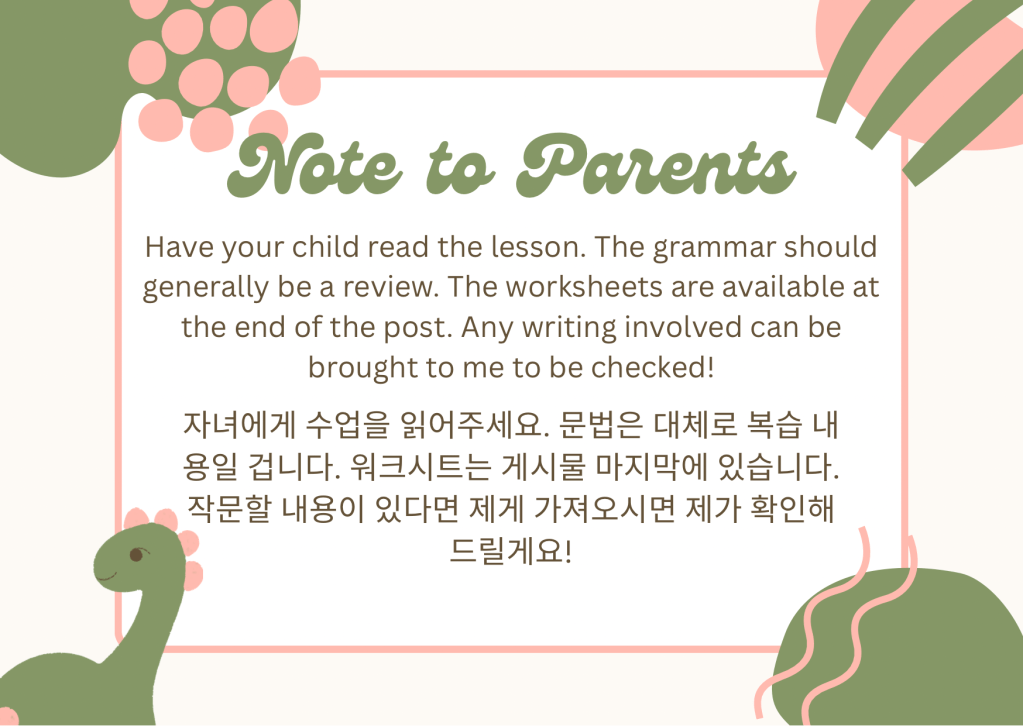
Note to parents: I recommend quizzing the student by saying the first word (“beat”) and have them say the last 2 words (“beat, beaten”) as the answer. You can also ask them to spell the word if it seems like they’re unsure. Put a star on the ones that they get wrong, and have them make flashcards to practice.
After you’ve studied the list, try this worksheet, and only look at the answers if you have to.
Note to parents: This is a difficult worksheet, and will take some time, maybe even several different sessions. I recommend having your child mark the ones they couldn’t remember or get wrong, and have them do the sheet one more time at a later time, when the words aren’t fresh in their mind. Another way to do this instead of having the student write the answers, is by reading the sentence aloud to them and have them fill in the blank verbally. This can help sharpen their listening skills as well.
Overall, this is a very simple grammar concept, but in practice it is hard to perfect. Even some native speakers still struggle with them, so don’t feel too bad if you can’t get it down perfectly! Good luck!

 Moselle T's Study Materials
Leave a comment