Welcome! I’m an ESL teacher based in Korea. This is my learning site for ESL 1st graders (or others!), where I’ll post free mini lessons and extra practice materials. Cheers!🌞
Have you ever read a paragraph and known exactly what it’s about just by reading the very first sentence? That first sentence is a very important topic sentence!
A topic sentence is like the “boss” of the paragraph. It tells you the main idea, so you know what you are going to read about. All of the other sentences in the paragraph give more details about that one main idea. Usually, it’s the first sentence in a paragraph.
What is a topic? It tells you WHO or WHAT the paragraph will talk about. So, it must be a person or object.
What is the main idea? The main idea tells you information ABOUT THE TOPIC.
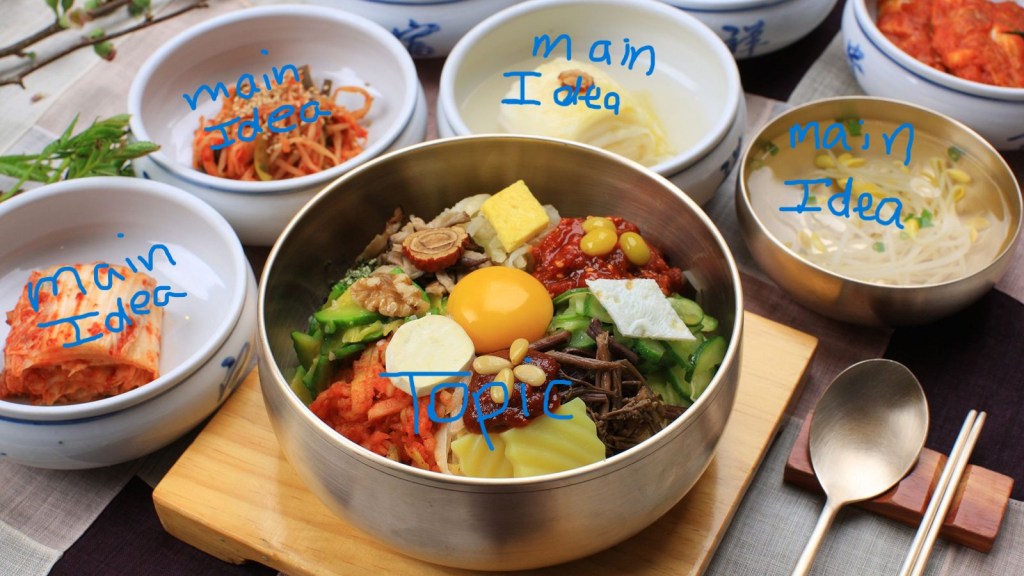
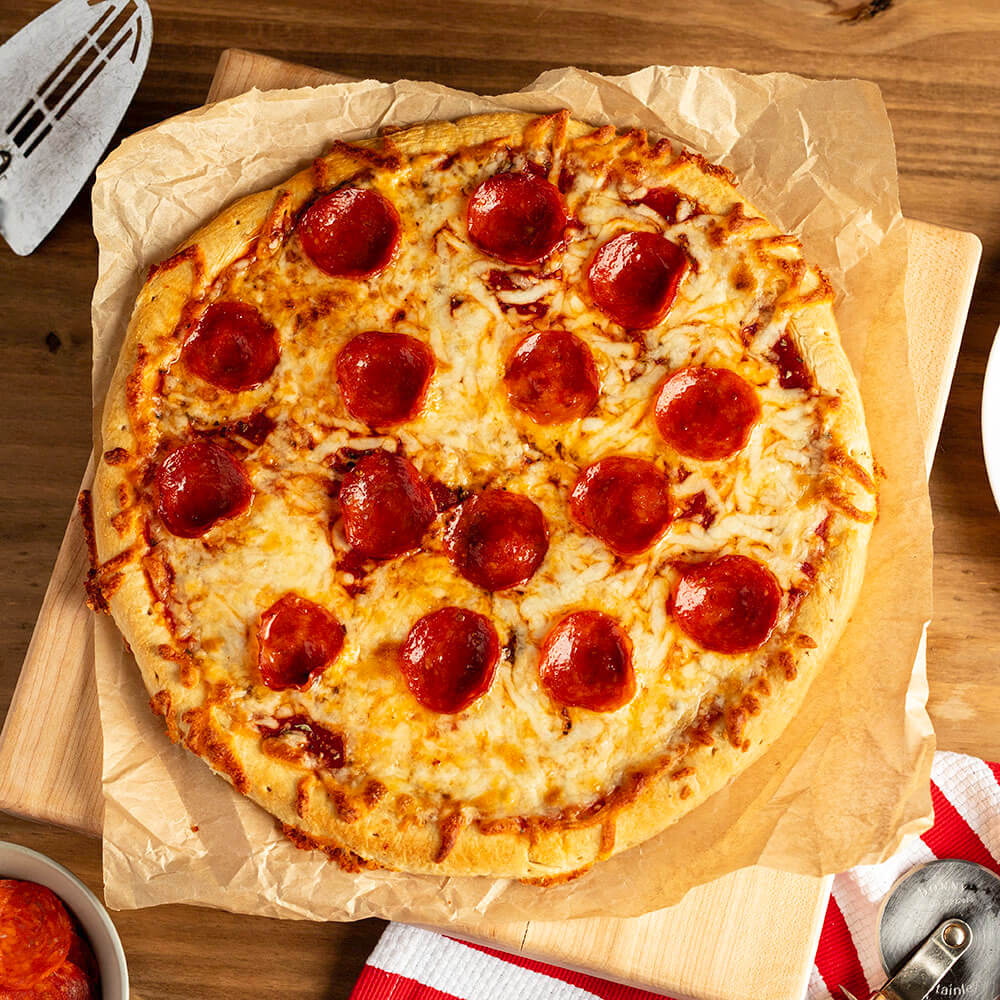
The topic is like the main dish at a restaurant, and the main idea is the side dishes that come with it.
My paragraph meal looks delicious…
So, here’s the formula for a topic sentence:
🧠 Topic + Main Idea = Topic Sentence
Let’s look at an example!
📖Read the paragraph:
My dog, Buster, is the best pet because he loves to play all the time. He will chase the red ball in the backyard. Then, he digs a big hole near the fence. After that, he loves to chew on his squeaky bone. Sometimes he runs very fast in circles. He is a very happy dog. He always has so much fun when we play together.
💡Let’s find the topic sentence and the main ideas!
What is the topic of this paragraph? (Who/what is being talked about?)
Answer: My dog, Buster
What is the topic sentence (the “boss” sentence)?
Answer: My dog, Buster, is the best pet because he loves to play all the time.
What are three main ideas (details) about Buster?
Answers (any 3 of these is correct):
He chases a ball in the backyard
He digs a hole near the fence
He chews on his squeaky bone
He runs very fast in circles
He is very happy
Note: when you write the main ideas, DO NOT just copy all of the sentences. That means you aren’t thinking about it- you’re just copying what you see.
🤔 Now, if you try to write your own new topic sentence for this paragraph, how would you do it?
First, add the topic: my dog, Buster (this won’t change, because the topic is the same)
Second, add the main idea. (This can change depending on how you want to say it):
Here’s some examples that I thought of: Buster never rests, Buster has a lot of energy, Buster is an excited dog
💡 Finally, put them together into one sentence:
My dog, Buster, has a lot of energy.
(Now we know that you will tell us about why he has a lot of energy!)
❗Important note: Some topic sentences will be a list (apples, oranges, lemons…), and some will be a statement/piece of information that tells us a fact (like Buster!). Both are great ways to write a topic sentence, and I suggest trying to use one of the 2 styles in your writing.
👍 These are the parts of a topic sentence, and how to make one. Now, try this worksheet, where you need to identify the topic, main ideas, and topic sentence by yourself, as well as create a new topic sentence for the paragraph. The writing for the 3 main ideas and new topic sentence creation can vary, and the sheet can be brought to me to be checked if so desired. The topic/topic sentence should not be different.
First, let’s remember what an adjective is. An adjective is a word that describes a person, a place, or a thing. It gives us more information about a noun.
For example, in the sentence, “The happy girl played,” the word ‘happy’ is an adjective that describes the girl.
There are many different kinds of adjectives that tell us different things. Let’s look at some of them:
Opinion Adjectives: These words tell us what someone thinks about something.
📖 This second worksheet might prove a bit more challenging, as they have to first find the adjective on their own. I recommend not letting your child look at the list of types of adjectives for an added challenge.
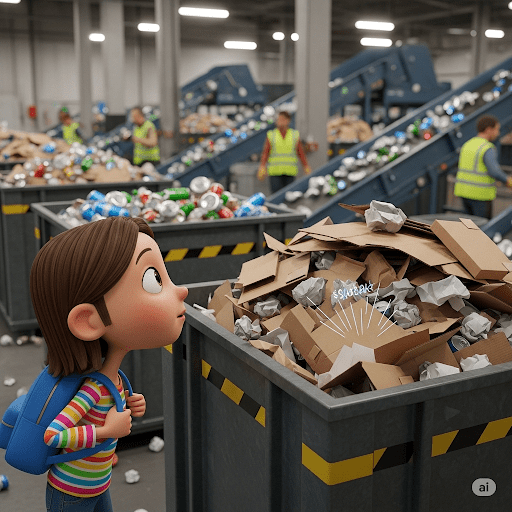
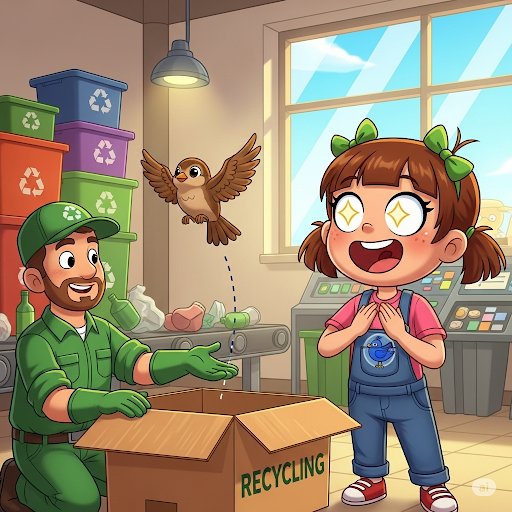
Maria was a second grader with bright, curious eyes that noticed everything. She loved adventures, and today felt like a big one. Her class was taking a trip to the city’s recycling center. The bus ride was a happy cacophony of songs and laughter. Maria bounced in her seat, imagining the huge machines and mountains of materials they were going to see. She couldn’t wait. When they arrived, the recycling center was even bigger than she had imagined. It was a single, cavernous room that echoed with noise. Giant piles of paper stood like skyscrapers, and mountains of colorful plastic bottles shimmered under the warehouse lights. The air smelled of metal and damp paper.
A guide showed them how big machines sorted everything with loud clanks and whirs. The whole place was like a giant, noisy labyrinth of conveyor belts and bins. Maria watched, fascinated by the organized chaos. It was interesting how old, forgotten things were being prepared to become something new. As the class walked past a tall bin overflowing with cardboard, Maria heard a minuscule sound. Chirp, chirp, chirp! It was a weak, scared sound, almost lost in the noise of the machinery. She paused, letting her friends walk ahead. She scanned the area, her eyes searching for the source of the tiny plea.
Her eyes landed on a huge cardboard box that had been flattened and folded over. Tucked deep inside a fold, so small she almost missed it, was a little brown bird. It was completely trapped. Its wings fluttered frantically, but it was stuck fast.
Maria’s heart gave a sad little thump inside her chest. The bird was in trouble, and the big machines were getting closer to this area. She knew, instinctively, that she had to do something, and she had to do it quickly. The little creature’s life might depend on it.
A feeling of desperation began to creep in as Maria looked around. Her teacher was listening to the guide, and her friends were laughing at a machine that crushed cans with a loud CRUNCH. No one else had heard the tiny chirps. “I have to help it,” she whispered to herself. She grabbed the edge of the flattened box and pulled with all her might. It was heavy and awkward, and it barely moved an inch. The task felt daunting. She looked around for a tool, maybe a stick or a piece of metal she could use to pry the cardboard open. But the floor was clean and clear. There was nothing she could use. She tried to pull the thick layers of cardboard apart gently with her fingers, but they were too strong. Maria felt a wave of hopelessness wash over her.
Just then, Maria saw a man in a bright yellow vest sorting cans nearby. He had a kind face. Maria felt shy. Her stomach did a little flip. What if he was too busy? What if he thought she was being silly and getting in the way? The man seemed focused on his work, and she didn’t want to interrupt him.
She stood there for a long moment, her hesitation feeling like a heavy weight. But then she thought about the distressed bird, and a feeling of determination pushed her shyness away. She summoned all her courage. She had to try.
She took a deep breath and walked over to him. “Excuse me,” she said in a small but clear voice. The man stopped his work immediately and looked down at her, his expression showing warmth and empathy. “A bird, you say? Show me.” He approached the box with Maria to see the problem.
“You have very good eyes,” the worker said to Maria. “Let’s see if we can get your little friend out.” He carefully took hold of the heavy cardboard with his strong hands and lifted one side, creating a small opening. Whoosh! In a flash of brown feathers, the liberated bird flew out of the box.
It soared up, circled once in the big, open room as if to say thank you, and then zipped out through a high window into the blue sky. Maria watched it go, a huge smile on her face. She felt a profound sense of relief and accomplishment bubble up inside her chest. The worker patted her shoulder. “That was a very kind thing to do,” he said.
For the rest of the day, Maria couldn’t stop thinking about the bird. On the bus ride home, the loud noises of her friends faded away as she looked out the window. She had learned that even in a big, busy world, it was important to pay attention to the small things. She felt proud. She had noticed something no one else did, and because of her, a little creature was free.
Hello grammar geniuses! Today, we’re going to learn about some special words that help us talk about things. These words are called demonstrative pronouns. They help us point to things and show if they are near or far from us.
The four words are: this, that, these, and those.
The words all start with T, but they have very different meanings!
This and That (For ONE thing!)
We use this when we are talking about one thing that is close to us.
“This is an apple.” 🍎 (The apple is right here!)
“This is my book.” 📚 (The book is in my hand!)
We use that when we are talking about one thing that is far away from us.
“That is a cloud.” ☁️ (The cloud is way up high!)
“That is a big tree.” 🌳 (The tree is far away in the park!)
These and Those (For MANY things!)
We use these when we are talking about many things that are close to us.
“These are my toys.” 🧸🚗 (The toys are all around me!)
“These are my friends.” 👫👭 (My friends are standing right next to me!)
We use those when we are talking about many things that are far away from us.
“Those are the stars.” ✨ (The stars are far away in the sky!)
“Those are the mountains.” 🏔️ (The mountains are far away!)
You can look back at this chart while you do the worksheets if you forget!
📖 Practice! Worksheet 1: Circle the correct pronoun!
I recommend this worksheet to students who have an extra hard time with the demonstrative pronouns. It is basic practice to become familiar with the meaning of the words, and very accessible.
Directions: Look at the pictures and circle the correct word. Then, write “close” or “far” on the first line and “one” or “many” on the second line.
(I split the files into 2 separate ones because the file was too large to upload to this post! The Answer Key is at the end of the 2nd file.)
This is a rudimentary worksheet, and most students should be able to complete it with little difficulty. If they need a lot of help with this, have them review the Comparison Chart above a few more times (you can ask them to chant it aloud), then try it one more time.
Directions: Read the sentence and fill in the blank with THIS, THAT, THESE, or THOSE.
📖 Even More Practice! Worksheet 3: Pronoun and Verb Connection
This worksheet makes the student think about the verb in connection to the pronoun. By now, they should be aware that “is” = one and “and” = many. The worksheet might be a bit challenging for some students, because it requires deeper thought.
Directions: Read the sentence and circle the correct pronoun and verb.
Hello, grammar learners! Today, we are going to learn about two very special kinds of pronouns: possessive and reflexive pronouns. Don’t worry, they are not as tricky as they sound!
❓️ What is a Pronoun? First, let’s remember what a pronoun is. A pronoun is a small word that takes the place of a noun (a person, place, or thing). For example, instead of saying, “Sarah is happy,” we can say, “She is happy.” “She” is the pronoun!
🌟 Now, for Possessive Pronouns: Showing Ownership Possessive pronouns are used to show that something belongs to someone. They answer the question, “Whose is it?”
Here are some common possessive pronouns: * mine (This is my book. The book is mine.) * yours (This is your pencil. The pencil is yours.) * his (This is his jacket. The jacket is his.) * hers (This is her dog. The dog is hers.) * ours (This is our ball. The ball is ours.) * theirs (This is their house. The house is theirs.)
Examples: * “The lunchbox on the table is mine.” (It belongs to me.) * “That bicycle is hers.” (It belongs to her.) * “We shared the cookies. All of them are ours.” (They belong to us.)
🌟 Next, the Reflexive Pronouns: Talking about Yourself!
Reflexive pronouns are used when the person doing the action is also the person who receives the action. They “reflect” the action back to the subject, like a mirror! They all end in -self or -selves.
Here are some reflexive pronouns: * myself (I made the sandwich myself.) * yourself (You should be proud of yourself.) * himself (He fixed the toy himself.) * herself (She taught herself how to play the piano.) * itself (The robot can move by itself.) * ourselves (We built the fort ourselves.) * yourselves (You need to clean the room yourselves.) * themselves (They can take care of themselves.)
Examples: * “I drew this picture myself.” (I am the one who drew it.) * “He cooked dinner for himself.” (He cooked it for no one else but him.) * “The children found the lost puppy themselves.” (They found it without help.)
❓️ What’s the difference? Possessive pronouns show ownership, while reflexive pronouns show that the subject of the sentence is also the object of the action. * Possessive: “The book is mine.” (The book belongs to me.) * Reflexive: “I read the book myself.” (I am the one who read the book.)
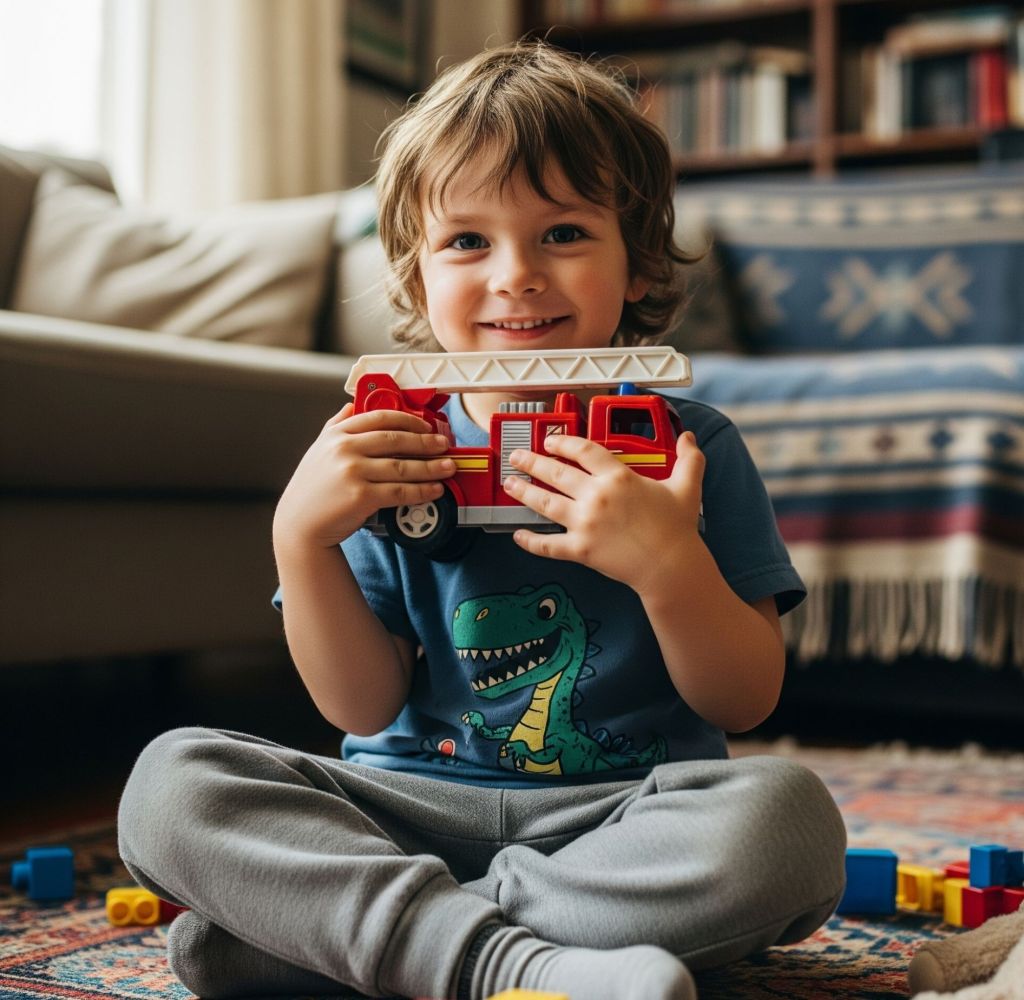
The toy car is ____.She read the book _________.
🧐 To put it in the simplest words possible: Possessive = mine🙋♂️ Reflexive = same person👯♀️
📖 Here is the first worksheet: Fill in the Blanks
Directions: Use the correct possessive or reflexive pronoun to complete each sentence. Choose from the words in the box. There is a bold hint in the sentence. If there is no hint, I have provided one at the end of the sentence.
This second worksheet is a little more challenging:
📖 Find the Mistake!
Directions: Read each sentence. The underlined pronoun is wrong. Circle the incorrect pronoun and write the correct possessive or reflexive pronoun on the line.
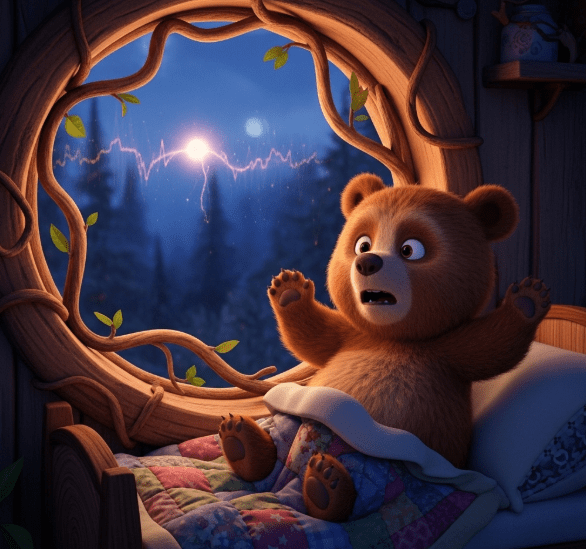
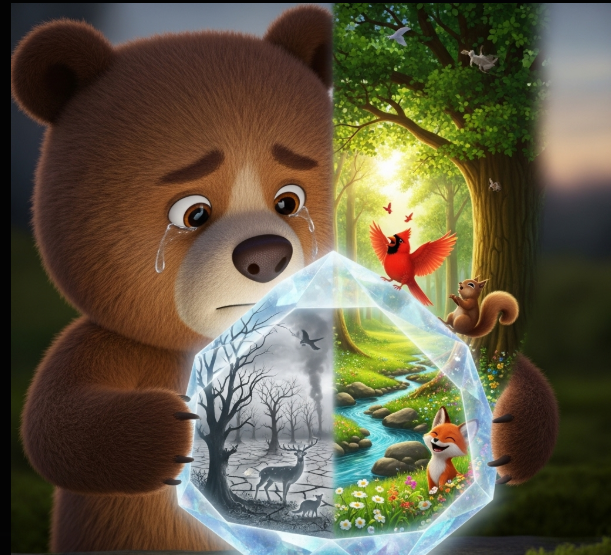
At dawn, little bear Bobo woke up with a jolt! A strange, soft light was pulsing from outside his window. It wasn’t the warm, friendly sun. This light felt… wrong. His heart thumped a little faster, a tiny drum in his chest. He had to see what it was! He quickly got dressed, his sleepy yawns replaced by a growing sense of urgent curiosity.
Bobo crept to the kitchen, his paws silent on the wooden floor. His mom was still asleep, a gentle snore filling the quiet room. He grabbed a quick, delicious berry cookie, barely tasting it. “This calls for an adventure breakfast!” he thought, crunching quickly. He carefully opened the back door, the mysterious light pulling him forward into the cool morning air.
The forest was still draped in shadows, but the strange light seemed to call to him, brighter now. He followed a small, hidden path that meandered deeper into the lush trees. The light grew stronger with every step, making the dewy leaves glimmer with an unnatural glow. This was no ordinary morning walk; it felt like he was walking into a dream, or perhaps a secret that wasn’t meant to be found.
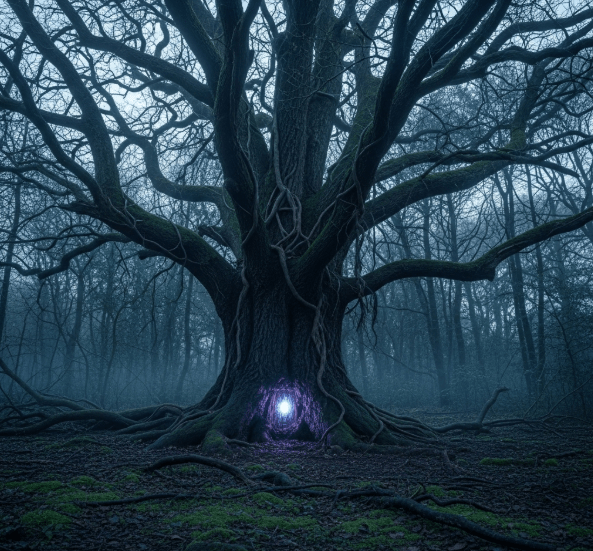
Suddenly, the path opened into a clearing. In the center, stood an enormous ancient tree, much bigger and older than any he had ever seen. Its branches twisted like gnarled, shadowy arms. The strange, pulsing light was coming from a tiny, almost hidden hole at the very base of this giant tree! Bobo felt a chilling mix of wonder and a strange sense of fear. What dark magic was inside?
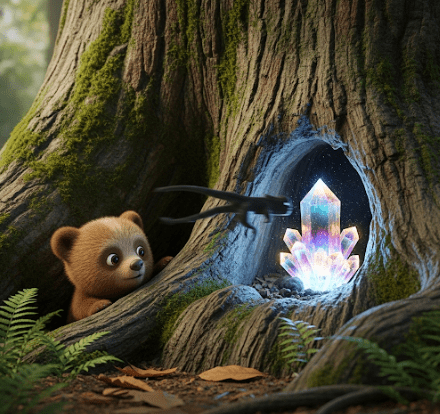
He bravely peeked into the hole. Inside, a beautiful, sparkling crystal glimmered with a powerful, rhythmic pulse. It filled the air with a strange hum, making the small hairs on Bobo’s neck stand up. He reached out a paw, drawn by its magic, but just as his paw almost touched it, a shadowy form moved swiftly across the hole.
A small, brown owl was perched on a branch directly above the hole, its large, unblinking eyes fixed on Bobo. “Whoo… whoo… Little bear, you should not be here,” the owl murmured softly, its voice like dry leaves scraping together. “That crystal holds a great power, and a great, terrible warning.” Bobo froze, his paw still in the air. He hadn’t seen the owl come!
“A warning?” Bobo whispered back, his voice barely audible. “What kind of warning?” The owl dipped its head slowly. “The crystal shows the forest’s true heart. It protects us. But if you touch it without respect, it will show you what happens when that heart breaks. It shows the future if we are not careful.” A shiver of dread ran down Bobo’s spine.
Bobo felt a surge of curiosity mixed with fear. What did the owl mean by a “broken heart”? And a future warning? He looked at the crystal again. It seemed to pulse faster, as if impatient. He knew he had to understand. This wasn’t just about a pretty light; it felt like the fate of the forest rested on his small paws.
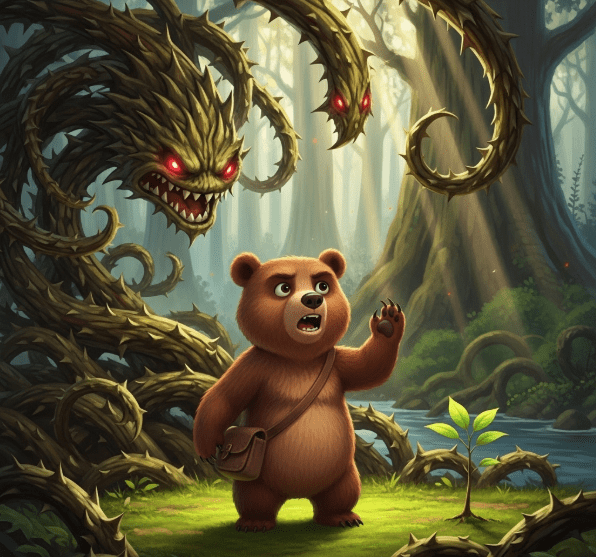
He tried to reach the crystal again, his paw trembling with anticipation. But just then, thick, thorny vines burst out from around the hole, twisting and growing, forming a menacing barrier! They were sharp, dark, and seemed to grasp at the air. “Oh no!” Bobo cried, pulling his paw back sharply. “How can I get through this?” The owl hooted, a sad, knowing sound. “Only a promise from a truly caring heart can make the thorns yield.”
Bobo thought hard, his mind racing. He remembered his mom always saying, “Nature gives us everything. We must give it care, or it will fade.” He looked at the angry, dark vines. “Please move, beautiful vines,” he spoke, his voice clear and true, filled with a sudden, strong resolve. “I promise, I will always care for our forest. I will protect its trees and rivers. I will make sure its heart stays strong and healthy!”
To his astonishment, the thorny vines slowly, painfully, began to pull back, but as they did, a horrifying vision swirled inside the crystal. He saw the beautiful, lush forest he knew, but then, like a terrible, fast-forwarded nightmare, the trees withered, their leaves falling like ash. The rivers dried up, turning to cracked earth. The animals looked sad, thin, and slowly disappeared. It was a forest dying, empty and silent, because no one had cared. Bobo gasped, tears forming in his eyes. The vision then changed, showing the forest vibrant and alive, full of song and laughter, as long as it was loved. He understood. He gently touched the crystal, a deep sense of responsibility washing over him. He knew his journey had changed him forever.
With the forest’s secret truly understood and the dire warning seen, the light from the crystal shone one last, brilliant time, then softly faded back to a gentle glimmer. Bobo turned to thank the owl, but it had silently wandered away into the vast expanse of the forest, its message delivered. The forest felt heavy, yet full of purpose. Bobo knew his mission now. As the sun began to set, painting the sky with colors, he headed home, carrying the weight and wonder of the forest’s future in his heart. Back in his comfortable bed, he felt content not just with a discovery, but with a promise made. He closed his eyes, already dreaming of how he would protect his beloved, magical forest from the silent, terrible threat of neglect.
Here are comprehension questions for the reading, including some open-ended ones:
Hopefully if you are doing this lesson, you at least have an idea of what an ADJECTIVE and an ADVERB are! However, if you forgot, here’s a short review:
Both are about describing something. What is the difference?
ADJECTIVES describe NOUNS, and ADVERBS describe VERBS.
🌟🌟Make sure you know what a noun and verb are before starting this lesson!🌟🌟
What are adjectives? Adjectives are words that describe nouns. Remember, nouns are people, places, things, or animals (like boy, park, book, cat). Adjectives tell us what a noun looks like, feels like, how big it is, or what color it is.
Think about a happy girl. (Happy tells us about the girl!)
Look at a big house. (Big tells us about the house!)
See a red apple. (Red tells us about the apple!)
Pat a fluffy cat. (Fluffy tells us about the cat!)
What are adverbs? Adverbs are words that describe verbs (actions!). They tell us how, when, or where something happens. Many adverbs end with -ly!
He runs quickly. (Quickly tells us how he runs!)
She sings loudly. (Loudly tells us how she sings!)
They play happily. (Happily tells us how they play!)
Here is a worksheet to practice both adjectives and adverbs! There are 4 different exercises available. On the story writing page (Exercise 4), feel free to bring it to me to have it checked!
Welcome to the first Journal Writing post! Although you probably have some experience writing journals already, let me explain what they are to you:
What is a journal?
It’s where you can write your ideas, stories, and feelings! It’s not for school or a grade; think of it as a light writing practice.
In each journal, I will provide a prompt for you to write about. I recommend writing them with a pencill and paper, and not typing them, so that you can practice your handwriting.
🖊️ Things to try to do when writing:
✨ Write COMPLETE sentences.
✨Explain WHY and WHAT you mean about each sentence. Don’t write boring sentences!
✨Use GOOD words: Try to avoid easy words that aren’t fun or creative. Even if you make mistakes, it’s better to try than to give up!
✏️ Writing help and hints:
✨Ways to start sentences:
“I feel…”
“I am…”
“Today I feel…”
Today I…”,
“Yesterday I…”,
“I played with…”,
“It was…”
“I believe…”
“Have you ever…”
“It can…”
✨Make a list of some special words or phrases that you will use in your journal first. Then, look at the list while you write. That way, you won’t run out of ideas! (There will be a section for this on the worksheet.)
Don’t worry if your writing isn’t perfect!
Try to focus on ONE thing to work on while you write. For example, today you can focus on your handwriting, and next time you can focus on your grammar or spelling. Don’t feel like you need to be perfect all the time!
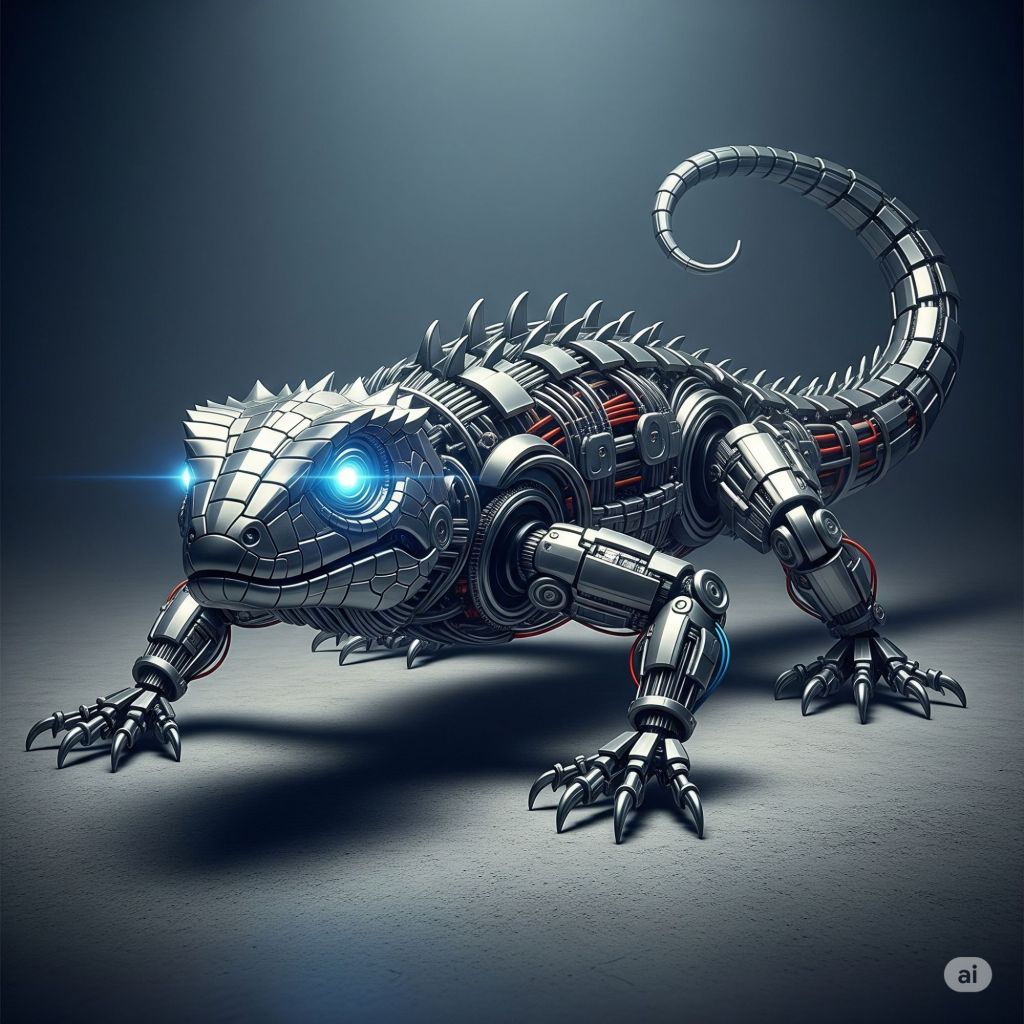
📖Today’s prompt: If you had a pet robot, what would it be like? How would it look? What could it do? Would it be better or worse than having a real pet?


















 Moselle T's Study Materials